Choosing a steel spill pallet should start with the containers being stored, not simply the pallet size. Buyers need to determine drum count, container dimensions, total working load, required containment volume, handling method, liquid compatibility and available footprint. The applicable regulation must also be identified before a containment capacity is treated as a compliance requirement.
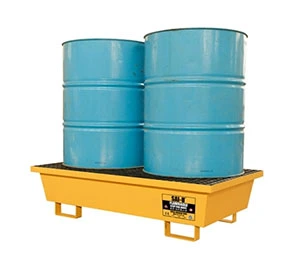
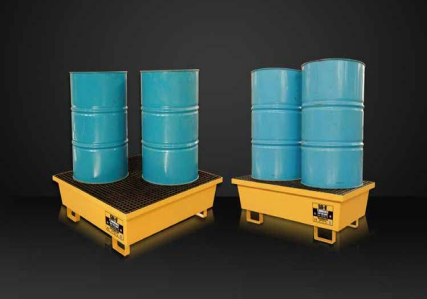
SAI-U provides several steel spill pallet configurations. Its published specifications include the ST0002 for 2 containers, with 22.6 L (6 gal) capacity, a 2,000 kg static load, and a 1,250 × 700 × 360 mm external size. The ST0004 accommodates 4 containers, with 37.8 L (10 gal) capacity, a 3,500 kg static load, and a 1,250 × 1,250 × 360 mm footprint.
The important purchasing question is therefore not “Which pallet is largest?” but “Which configuration matches the containers, load and containment requirement of this application?”
Which Steel Spill Pallet Size Fits Your Drums?
Definition: Steel spill pallet sizing is the process of matching container quantity, footprint, containment volume, working load and handling requirements to a suitable pallet configuration.
Start With Container Count, Diameter and Footprint
Determine the actual container arrangement before selecting the pallet.
For drum storage, record:
| Parameter | What to measure |
|---|
| Container count | Maximum number stored simultaneously |
| Container diameter | Actual outside diameter |
| Container height | Overall height including fittings where relevant |
| Container footprint | Space required for each drum/container |
| Total weight | Container + product + pallet |
| Handling method | Forklift, pallet jack or manual handling |
| Liquid type | Product name and relevant SDS information |
For example, SAI-U's ST0002 and ST0004 are configured for different numbers of containers, but the difference is not simply storage capacity. ST0004 provides a 1,250 × 1,250 mm footprint compared with 1,250 × 700 mm for ST0002, while its published static load increases from 2,000 kg to 3,500 kg.
This makes footprint and load rating just as important as drum count.
A useful rule for procurement is to draw the proposed container arrangement to scale before requesting the quotation. The drawing should show container centers, pallet perimeter, access direction and the intended handling path.
Allow Space for Loading, Inspection and Dispensing
The pallet should not be selected solely because the containers can physically sit on its grating.
Allow enough working space for loading, visual inspection and, where applicable, dispensing operations. Consider whether operators need to reach valves, connect transfer equipment or remove a damaged container without moving every other container first.
The required clearance depends on the equipment and site procedure, so it should be defined by the actual operation rather than a generic “safety spacing” number.
How Do You Calculate the Required Sump Capacity?
Definition: Sump capacity is the volume of liquid that the spill pallet can collect within its secondary-containment area before overflow.
Containment capacity is one of the most frequently misunderstood spill pallet specifications because the correct requirement depends on the regulatory regime and application.
For certain U.S. hazardous-waste container storage areas regulated under 40 CFR 264.175, the containment system must have sufficient capacity for 10% of the volume of all containers or the volume of the largest container, whichever is greater. The rule also addresses accumulated precipitation and run-on.
This calculation should not be presented as a universal requirement for every chemical storage application or every country.
Example: Two 55-Gallon Drums
Assume a facility stores two 55-gallon containers containing free liquids.
Total container volume:
55 + 55 = 110 gal
10% of total volume:
110 × 10% = 11 gal
Largest container:
55 gal
Under the cited 40 CFR 264.175 calculation, the greater value is therefore 55 gal.
This example shows why drum count alone is not enough. A pallet advertised as a “2-drum spill pallet” may still require additional regulatory review depending on the container size and applicable rule.
Example: Four 55-Gallon Drums
For four 55-gallon containers:
55 × 4 = 220 gal
10% of total:
220 × 10% = 22 gal
Largest container:
55 gal
The resulting benchmark under that specific regulation remains 55 gal, because the largest-container value exceeds 10% of the aggregate volume.
SAI-U's published ST0004 specification lists 37.8 L (10 gal) of capacity. Therefore, a buyer should not automatically describe ST0004 as meeting a 55-gallon containment requirement for four 55-gallon drums. The published product specification and the applicable regulatory requirement must be compared for the actual project.
For U.S. projects, buyers should confirm the exact regulatory framework with their EHS or compliance team before finalizing the pallet.
How Do You Match Working Load to Drums and Handling?
Definition: Working load is the weight the spill pallet is designed to support under the manufacturer's stated loading conditions.
Container capacity and load capacity are separate specifications.
A pallet may have adequate sump capacity but still be unsuitable if the combined weight of the drums and liquid exceeds its rated load.
For example:
| Model | Container count | Published capacity | Static load | External size |
|---|
| SAI-U ST0002 | 2 | 22.6 L / 6 gal | 2,000 kg | 1,250 × 700 × 360 mm |
| SAI-U ST0004 | 4 | 37.8 L / 10 gal | 3,500 kg | 1,250 × 1,250 × 360 mm |
| SAI-U ST0302 | 2 | 52.9 L / 14 gal | 1,500 kg | 1,250 × 700 × 1,020 mm |
These are SAI-U's published model specifications.
The table illustrates why a model should not be chosen from drum count alone. ST0302, for example, has a higher listed containment volume than ST0002 but a lower published static load.
Separate Static Capacity From Operational Load
The buyer should calculate:
Total working load = container tare weight + product weight + other supported equipment
If dispensing equipment, transfer pumps or other components will sit on the pallet, confirm whether they are included in the manufacturer's rated loading conditions.
For forklift applications, also confirm how the pallet is intended to be moved. SAI-U's steel spill pallet range specifies forklift handling for ST0002 and ST0004, while ST0302 is listed as movable.
Do not assume that two pallets with similar dimensions have identical handling characteristics.
How Do You Check Material Compatibility and Exposure Conditions?
Definition: Material compatibility means confirming that the spill pallet's construction, coating and containment surfaces are suitable for the liquid and operating environment.
The pallet must be considered together with the chemical being stored.
OSHA's Hazard Communication Standard requires employers to maintain accessible SDS information for hazardous chemicals, and SDS Section 7 addresses handling and storage while Section 10 addresses stability and reactivity.
For procurement, the SDS should therefore be part of the technical information supplied to the manufacturer.
SAI-U's steel spill pallet uses 3 mm hot-rolled steel plate with an epoxy resin powder coating, and the company describes the design as intended for oil drums and chemical containers.
That does not mean every chemical is automatically compatible with the coating or steel construction. The actual liquid, concentration, temperature and exposure conditions should be reviewed.
Where aggressive chemicals, unusual temperatures or outdoor exposure are involved, request written confirmation of material and finish suitability before purchase.
What Should Be Included in a Steel Spill Pallet RFQ?
Definition: A steel spill pallet RFQ matrix is a structured set of container, containment, load, footprint, material and handling requirements used to obtain a technically comparable quotation.
A strong RFQ reduces the risk of receiving a technically different product under the same “4-drum spill pallet” description.
| RFQ Parameter | Buyer Provides | Supplier Confirms |
|---|
| Container count | 2, 4, or other | Recommended model |
| Container type | Drum, pail, IBC, etc. | Physical compatibility |
| Container size | Diameter, height, volume | Layout |
| Total weight | Maximum loaded weight | Static load rating |
| Containment target | Applicable rule/value | Available sump capacity |
| Footprint | Available floor space | External dimensions |
| Handling | Forklift/pallet jack/manual | Handling configuration |
| Liquid | Product + SDS | Material/coating suitability |
| Environment | Indoor/outdoor, corrosion exposure | Finish recommendation |
| Grating | Required/removable | Material and loading specification |
| Drain | Required/not required | Drain size and configuration |
| Documentation | Drawing/certificates/specs | Available documents |
SAI-U also offers a broader steel spill pallet product range and drum spill pallet range, so buyers can compare steel configurations with other drum-containment options according to the application.
For a wider secondary-containment requirement, SAI-U's spill containment equipment range includes additional containment products.
What Data Should You Send Before Requesting a Quote?
For an accurate quotation, send the manufacturer the container count, container dimensions, total loaded weight, liquid/SDS, required containment basis, available footprint, handling method and installation environment.
For IBC applications, SAI-U's published product range includes IBC spill pallet models such as IBC020 and IBC090. However, the accessible product-listing data does not provide enough model-specific technical information here to substitute an IBC specification for the steel ST0002/ST0004 data, so buyers should request the exact IBC model drawing and containment specifications before comparing it with a steel pallet.
Conclusion: Size the Spill Pallet From the Application, Not the Label
Selecting a steel spill pallet requires more than matching “2 drums” or “4 drums” to a product name.
The buyer should first establish the actual container footprint, total working load, required containment volume, liquid compatibility, handling method and applicable regulation. Only then should the pallet model be selected.
SAI-U's published steel range demonstrates the importance of comparing specifications: ST0002 is listed for 2 containers with 22.6 L capacity and 2,000 kg static load, while ST0004 is listed for 4 containers with 37.8 L capacity and 3,500 kg static load.
For U.S. hazardous-waste container storage, 40 CFR 264.175 provides a specific containment calculation based on 10% of aggregate container volume or the largest container, whichever is greater; other applications may be governed by different requirements.
For a project quotation, send SAI-U the drum count, container dimensions, liquid type/SDS, maximum loaded weight, required containment basis, available footprint and handling method. This allows the supplier to compare suitable models and provide an RFQ based on the actual operating conditions.
Request a spill pallet comparison: Send your drum count, container size, liquid type, total load and applicable containment requirements to SAI-U.
Frequently Asked Questions About Steel Spill Pallets
How Much Sump Capacity Does a Spill Pallet Need?
There is no single global number. For certain U.S. hazardous-waste container storage areas under 40 CFR 264.175, the containment system must hold 10% of the total container volume or the largest container volume, whichever is greater. Other regulatory regimes may use different requirements.
Can Two Different Drums Share One Steel Spill Pallet?
They may be physically compatible with the same pallet, but the decision should consider drum dimensions, total weight, liquid compatibility, segregation requirements and the applicable storage procedure. The manufacturer should confirm the proposed layout before purchase.
Does a Steel Spill Pallet Need a Drain?
A drain can simplify removal of collected liquid, but whether it is appropriate depends on the pallet design, stored material and site procedure. SAI-U's steel spill pallet specifications include a 3/4-inch NPT ball-valve arrangement for transferring collected liquid on its steel pallet design.
What Is the Difference Between Sump Capacity and Load Rating?
Sump capacity is the amount of liquid the containment area can hold. Load rating is the weight the pallet is designed to support. These specifications measure different performance characteristics and should be checked separately.
Are Steel Spill Pallets Suitable for All Chemicals?
No. Compatibility should be evaluated using the actual chemical, concentration, temperature, SDS information and pallet construction/coating. A steel pallet should not be considered universally compatible simply because it is designed for chemical storage.
What Should I Send a Manufacturer for a Spill Pallet Quote?
Provide the container count and dimensions, liquid/SDS, maximum loaded weight, required containment basis, available footprint, handling method and environmental conditions. These details give the manufacturer enough information to recommend a suitable configuration rather than quoting by drum count alone.
 English
  日本語
日本語  한국어
한국어  français
  Deutsch
  Español
  italiano
  русский
  português
  ไทย
ไทย  العربية